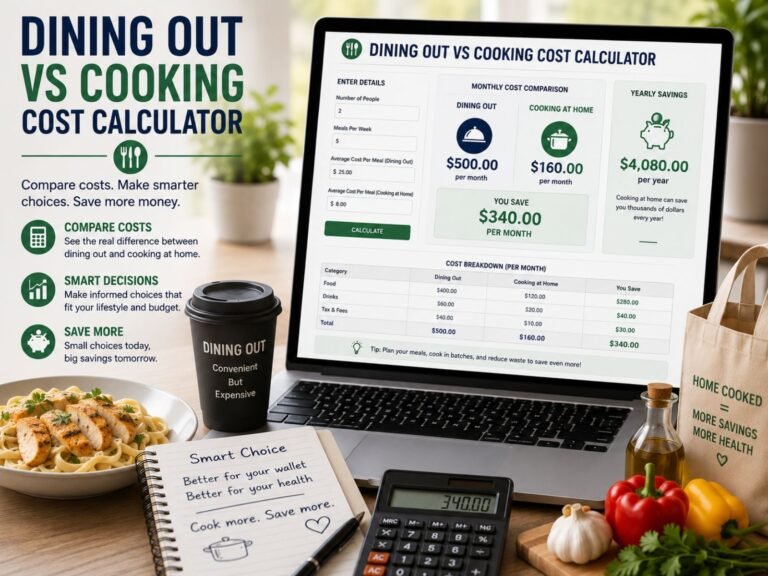
Monthly Grocery Bill Calculator
Estimate Your Grocery Budget
Enter your household characteristics below to generate an automated food budget forecast.
Weekly Target
Monthly Total Budget
*Projections are generated using average index values updated for baseline consumer food tracking metrics. Household habits and local tax conditions will cause variances.
Food is one of the most significant variable expenses in any household budget. Unlike fixed costs like rent or car payments, your grocery bill fluctuates based on inflation, dietary preferences, family size, and simple lifestyle choices. Because these costs are flexible, they present a massive opportunity to save money—if you track them properly.
Our interactive calculator above is designed to help you map out, anticipate, and manage your household’s food expenditures. By evaluating the size of your family, your preferred dietary style, and local cost-of-living adjustments, this tool offers a realistic baseline estimation to keep your financial goals on track.
Why Use a Grocery Budget Calculator?
With supply chain fluctuations and rising food inflation, walking into a supermarket without a plan can break your budget. Studies show that shoppers without a predefined list or budget spend up to 40% more on impulse buys. Using a calculator allows you to reverse-engineer your spending. Instead of wondering where your money went at the end of the month, you can allocate dynamic weekly and monthly targets to guide your shopping trips.
How Our Calculator Estimates Your Costs
This tool blends demographic data with standard economic spending tiers to create customized projections. To get an accurate forecast, input the following metrics:
- Household Composition: The numbers adjust automatically for adults and children, as nutritional needs and serving sizes vary significantly across age brackets.
- Dietary Tier Plan: Modeled after standard nutritional spending indexes, you can choose from Thrifty (strict budgeting/generic brands), Moderate (a balance of fresh produce and convenience), or Premium/Organic (high-end markets, specialized diets, and organic selections).
- Cost of Living Index: Grocery pricing varies radically between rural communities, mid-sized suburbs, and dense metropolitan cities. Adjusting this scale ensures localized accuracy.
- Meals Prepared at Home: Eating out handles part of your nutrition. Telling the calculator how often you cook scales your grocery needs appropriately.
Practical Strategies to Lower Your Monthly Food Expenses
If the results from the calculator are higher than you would like, you don’t have to sacrifice nutritional quality to cut costs. Consider implementing these proven budgeting frameworks:
- Embrace Batch Meal Planning: Map out your meals for the week before leaving the house. Base your ingredient lists on overlapping items to eliminate food waste.
- Prioritize Store Brands: Most private-label store brands feature identical nutritional profiles and ingredients as name brands for 20% to 30% less money.
- Buy Staple Items in Bulk: Grains, beans, oats, and frozen proteins have long shelf lives and offer a much lower cost-per-ounce when purchased in bulk formats.
- Track Waste Closely: The average household throws away nearly 25% of the groceries they buy. Audit your refrigerator weekly and build a “use first” bin for expiring items.
Frequently Asked Questions
What is the average monthly grocery bill for a single adult?
On average, a single adult spends between $250 and $450 per month on groceries. The lower end reflects budget-conscious shopping using meal prep and generic lines, while the higher end encompasses premium organic buying habits and convenience food alternatives.
How much should I realistically spend on groceries per week?
A standard baseline range is $60 to $100 per week per individual adult. Families generally spend less per person due to bulk buying economies of scale, dropping the individual weekly breakdown for large groups down closer to $50–$75 per person.
Does our calculator account for household items like paper towels and soap?
This calculator focuses specifically on consumable food indices. If you regularly purchase non-food toiletries, cleaning chemicals, pet goods, or paper supplies at the supermarket, we recommend adding roughly 10% to 15% to your final calculated projection.
What percentage of my income should go toward groceries?
Financial planners typically suggest allocating between 10% and 15% of your total take-home pay to food costs. This percentage should cover both supermarket groceries and any dining out or food delivery experiences combined.
Why are grocery bills rising faster than general inflation markers?
Supermarket products are uniquely vulnerable to dynamic agricultural variables, changing energy and fuel transport costs, localized labor challenges, and global supply chain reconfigurations. Small bottlenecks anywhere along the production pipeline quickly compress retail margins, raising consumer costs.
Is buying organic foods really worth the added budget premium?
From a budgeting perspective, organic items can elevate individual grocery bills by 20% to 50%. If you want to optimize your financial efficiency, buy conventional items for products with thick discardable skin (avocados, bananas) and prioritize organic allocations for items where the skin is consumed (berries, spinach).
How can I cut my grocery costs immediately without eating less food?
The fastest structural adjustments involve minimizing processed snack foods, opting for generic supermarket brand equivalents, adjusting protein choices toward plant-based alternatives (beans, lentils) multiple times a week, and checking your current kitchen inventory before going to the store.
Is buying food in bulk always more cost-efficient?
Not inherently. Bulk buying reduces the price-per-ounce on stable goods (rice, dry items, spices). However, buying perishable goods like large produce containers or fresh dairy in bulk often leads to home spoilage, completely erasing the initial transaction savings.
Does eating out save money by reducing grocery waste footprints?
No. Restaurants apply markup charges (typically 300% or more over wholesale food metrics) to pay for operational staff overhead and retail location leasing. Preparing food at home remains the primary driver of household savings across all income brackets.
How can I track my grocery spending effectively month over month?
You can leverage a dedicated budgeting app, maintain a basic spreadsheet tracking checkout totals, or utilize the envelope system—placing a set cash amount inside an envelope at the start of the month dedicated solely to supermarket checkout registers.